
Introduction
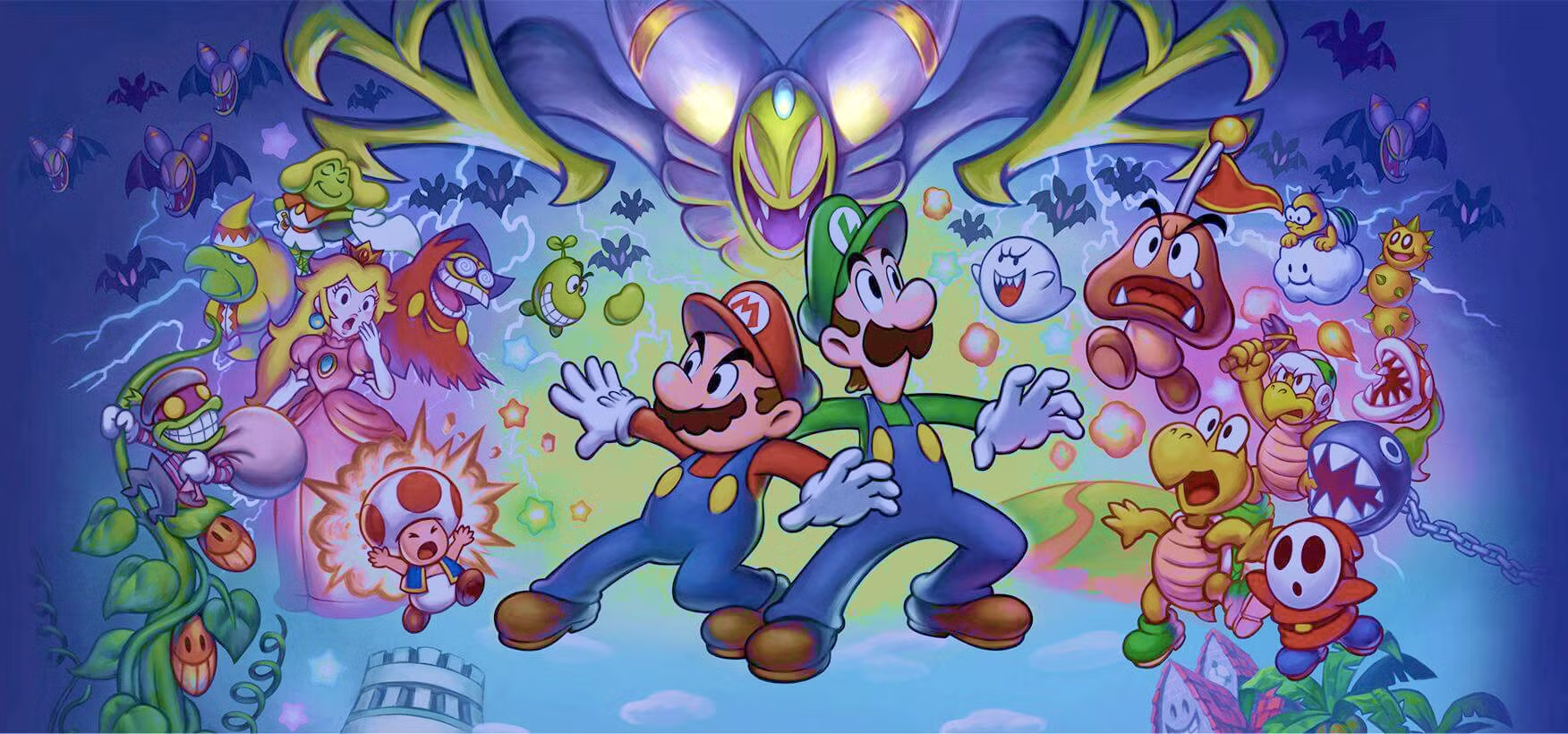
Mario Luigi Superstar Saga isn’t just a “Mario RPG.” It’s a tightly designed adventure that rewards good timing, smart stat choices, and a surprisingly strategic approach to battles—while still being funny, approachable, and endlessly replayable. If you’ve ever bounced off turn-based RPGs because they feel slow, this is the exception: nearly every action, from basic attacks to defending, is interactive. You’re not just selecting moves; you’re performing them.
In this guide, I’ll walk you through everything that makes Mario & Luigi: Superstar Saga special—from the fundamentals of action commands and Bros. Moves to advanced combat habits, efficient builds, practical boss tactics, and completionist secrets. Whether you’re starting fresh in the Beanbean Kingdom or returning to optimize a playthrough, you’ll come away with a clear plan and better results in-game.
What Is Mario & Luigi: Superstar Saga?
Mario Luigi Superstar Saga is a turn-based RPG built around timing-based inputs and two-character control. You explore a connected world, solve environmental puzzles with duo abilities (Bros. Moves), and fight enemies using interactive attacks and defenses. The game’s identity comes from three pillars:
Exploration that constantly asks you to use Mario and Luigi together in creative ways.
Battles that feel almost like a rhythm game—success depends on your timing, not just your levels.
Progression systems (stats, beans, gear, and badges) that allow real customization if you understand what matters.
It’s also one of the funniest entries in the broader Mario RPG space, with expressive animations and a fast comedic pace that still holds up.
Story and Setting: Why the Beanbean Kingdom Works
The plot is simple on paper, but it’s executed with personality. Bowser’s voice gets stolen, the Beanbean Kingdom is in trouble, and Mario and Luigi are pulled into a political mess involving the villainous Cackletta. The writing leans on physical comedy and character reactions more than complicated lore, which is exactly why it stays charming instead of feeling dated.
What makes the Beanbean Kingdom memorable is variety. Towns and routes have distinct themes, NPCs feel like they belong in this weird world, and the game keeps introducing new mechanics at a steady pace. That pacing matters: Superstar Saga rarely lets you stagnate with the same tools for too long.
Core Gameplay Loop: Exploration, Puzzles, and Progress
At its best, Mario Luigi Superstar Saga feels like a constant “learn, use, remix” loop:
You unlock a Bros. Move (or upgrade).
The world opens in a new way.
Enemies are designed to push the battle skills you just learned.
Then the game escalates with a new twist.
Bros. Moves: The Real “Keys” of the Game
Bros. Moves are the duo techniques you use in the overworld—things like jumps that require coordination, digging, hand powers, and movement tricks. They aren’t just “gates” like in many adventure games; they’re also mini skill checks. Getting comfortable with controlling both brothers cleanly reduces frustration and speeds up everything, especially backtracking and secret hunting.
Practical insight: treat Bros. Moves like muscle memory training. Spend a minute practicing each new move in a safe area. That tiny investment pays off for the rest of the game because later puzzles often assume you can execute quickly.
Exploration Tips That Save Time
Check suspicious platforms and dead ends. The game hides beans and blocks in places that look slightly “extra.”
Revisit earlier areas after major upgrades. Many high-value permanent upgrades are tucked behind late-game abilities.
Pay attention to visual language. Superstar Saga is good at hinting where secrets are—odd rock colors, lonely ledges, or enemy placement that “guards” nothing usually means something is there.
Battle System Deep Dive: How Combat Actually Works
The battle system is turn-based, but it doesn’t play like a traditional menu RPG. You control two characters, each with their own actions, and you’re expected to actively perform both offense and defense.
Turn-Based, But Skill-Based: Action Commands Explained
Every basic attack has an action command:
Mario’s jump has timing windows for bounces.
Luigi’s jump is similar but can differ based on enemy behavior.
Hammers require precise timing to maximize damage and avoid penalties.
The same is true for most special attacks and even item usage in some versions. If you’re missing inputs, your damage drops dramatically, and fights feel longer than they should. If you’re landing inputs consistently, you can beat tougher encounters at lower levels.
Practical example: if a standard jump should land multiple bounces on a spiked or shelled enemy, the game often expects you to change approach (hammer vs jump) rather than brute forcing. Learning enemy “rules” is as important as timing.
Defensive Timing: Your Best “Stat” Is Skill
Defense is where Mario Luigi Superstar Saga separates casual success from expert control. Many enemy attacks can be:
Dodged with a jump
Blocked or countered with a hammer
Avoided by choosing the correct brother to react
When you defend well, you don’t need to over-heal, over-level, or burn through items. It’s the cleanest way to keep momentum.
Expert habit: watch the enemy’s wind-up animation, not the moment of impact. Your reaction should start when you recognize the tell, not when the attack lands. That one change makes late-game encounters feel dramatically easier.
Bros. Attacks: Damage, Control, and Efficiency
Bros. Attacks are the flashy special moves that consume Bros. Points (BP). They’re not all equal in real gameplay value. A good Bros. Attack does at least one of these:
Reliable high damage with manageable timing
Multi-hit potential that scales well into the late game
Utility like hitting multiple targets or bypassing annoying defenses
If you’re struggling, it’s often not because you’re under-leveled—it’s because you’re leaning on a Bros. Attack you can’t consistently execute. Pick the ones you can perform cleanly and build your BP usage around reliability.
Advanced perspective: consistency beats theoretical max damage. An attack that hits for “great” damage every time outperforms a “top-tier” move you botch under pressure.
Progression and Stats: How to Level Smart
Leveling in Mario Luigi Superstar Saga isn’t just “numbers go up.” You choose a bonus every time you level, which means you can shape each brother into a role—or build both into generalists.
Stat Breakdown (What They Do in Practice)
HP: survivability, especially useful if your defense timing is inconsistent.
BP: how often you can use Bros. Attacks before needing recovery.
POW: raw damage output, affects how quickly you end fights.
DEF: reduces incoming damage, useful when learning enemy patterns.
SPEED: turn order and frequency, can be surprisingly impactful in longer fights.
STACHE: affects lucky hits and certain outcomes like shop benefits and drops depending on context.
Beginner-friendly take: POW, BP, and a reasonable HP baseline tend to make the smoothest first playthrough because they forgive mistakes while still ending fights quickly.
The Level-Up Bonus System: How to Choose Correctly
Each level offers a roulette-style bonus. The trap is chasing the biggest number every time without thinking about your build. A smaller bonus in a stat you actually need can outperform a huge roll in something you rarely benefit from.
Practical approach:
Early game: prioritize BP and POW until combat feels comfortable.
Mid game: patch weaknesses—if you’re getting hit a lot, add HP or DEF.
Late game: specialize—push POW/SPEED for faster clears, or BP for frequent Bros. Attacks.
Beans: Permanent Boosts You Should Not Ignore
Beans are one of the most important long-term power systems. They provide permanent stat increases and are often hidden behind exploration or optional challenges. Many players accidentally treat them like collectibles with no urgency—then wonder why the late-game feels spiky.
Actionable advice: use beans regularly instead of hoarding. There’s no prize for saving them, and early boosts compound over the whole adventure.
Gear and Badges: Small Numbers, Big Impact
Equipment in Superstar Saga can quietly define your playstyle. Some gear focuses on offense, some on defense, and some includes effects that change how you approach encounters. Badges can add extra depth by enhancing certain actions, improving sustain, or leaning into luck.
Tip from experience: if you feel “stuck,” don’t just grind levels—re-check your gear. Swapping equipment to match the next area’s enemies often fixes difficulty spikes faster than leveling.
Practical Build Strategies (With Examples)
If you want a straightforward plan rather than guessing at level-ups, these builds work well.
Build 1: The Balanced Beginner Build (Smoothest First Run)
Mario: POW + BP focus, occasional HP
Luigi: BP + SPEED focus, occasional DEF
Why it works: Mario becomes a reliable damage dealer, while Luigi supports with more frequent turns and a deeper BP pool. This makes fights feel snappy without making you fragile.
Practical example: when facing groups, Luigi’s speed helps you stabilize the fight early—either by finishing weaker targets or setting up reliable Bros. Attack usage.
Build 2: High-Power Burst Build (Advanced, Faster Clears)
Mario: heavy POW, some SPEED
Luigi: heavy POW, some BP
Why it works: you aim to end fights before enemies get many actions. This build feels incredible if your defense timing is strong, because you won’t need the safety net of high HP/DEF.
Best used by: players confident with dodging and hammer counters.
Build 3: Stache-Focused Utility Build (For Fun and Drops)
Mario: POW + STACHE
Luigi: BP + STACHE
Why it works: you increase the frequency of lucky events and can tilt the economy and drops in your favor depending on how you play. It’s not always the fastest boss-killer, but it can be very satisfying and helps with resource flow.
Reality check: don’t go all-in on STACHE at the expense of core combat stats unless you truly enjoy the gamble. A “some STACHE” approach tends to be the sweet spot.
Money, Items, and Resource Management
Superstar Saga is generous, but you can still waste a lot of time and coins if you play reactively.
When to Use Items vs. When to Save Them
Use items to maintain momentum in long stretches or tough boss attempts. Saving everything “for later” often leads to messy wipes that cost more time than the items were worth.
A clean rule:
Use healing items when you’re about to lose control of the fight (both brothers low, or one brother repeatedly targeted).
Use BP items when you can secure a win quickly with a couple of reliable Bros. Attacks.
Efficient Farming Without Turning the Game Into a Chore
If you ever feel underpowered, do short, targeted loops rather than long grinding sessions. Ten minutes of focused battling in a good area is usually enough to stabilize your stats and confidence. The bigger performance gain often comes from improving defense timing and rethinking gear, not from chasing five extra levels.
Boss Strategy Mindset (With Practical Examples)
Bosses in Mario & Luigi: Superstar Saga are designed like skill exams. They test:
Whether you recognize attack tells
Whether you can choose the correct defensive response
Whether you can maximize safe damage windows
Example Approach: Learning a Boss in Two Attempts
Attempt 1 (data run): focus on surviving and learning patterns. Use basic attacks more than BP to avoid resource panic.
Attempt 2 (execution run): once you know the tells, spend BP aggressively to shorten the fight.
This mindset works across the game because most bosses become easy once their “language” is understood.
Dealing With Multi-Phase or Gimmick Fights
Some bosses change patterns mid-fight or add summons. The common mistake is continuing the same plan even after the fight has shifted. When you notice a new phase:
Slow down your inputs for a few turns.
Re-center on defense first.
Then ramp damage once you’ve confirmed the new timing windows.
If you’re consistently missing action commands during a boss, switch to a simpler, more reliable Bros. Attack. Flashy doesn’t help if it fails.
Secrets, Optional Content, and 100% Completion Habits
If you want to fully experience Superstar Saga, optional content isn’t just padding—it often includes meaningful upgrades.
How to Think Like a Completionist Without Getting Overwhelmed
Do a “light sweep” whenever you gain a major Bros. Move: revisit a couple of earlier hubs and check for newly accessible blocks/paths.
Mark mental notes of unreachable spots: the game loves teasing you with visible rewards you can’t grab yet.
Hidden Blocks and Environmental Rewards
Hidden blocks are a classic Mario staple, and Superstar Saga uses them to reward curiosity. If a room looks too empty or a platform seems oddly placed, test jumps and hammers in likely spots. Over time you’ll learn the developers’ hiding habits.
GBA Original vs. 3DS Remake: What’s Different and Which Should You Play?
Many players search “mario luigi superstar saga” because they’re unsure whether to play the original or the remake. Both are worth playing, but they feel different.
The Original (GBA): Snappy and Direct
The GBA version is fast, responsive, and has a distinct feel in animations and pacing. If you like crisp menus and a more straightforward presentation, it holds up extremely well.
The Remake (3DS): Polished Presentation and Extra Mode
The remake updates visuals, refines certain interface elements, and adds an additional mode (commonly known as Minion Quest) that plays very differently from the main RPG. The core adventure remains the star, but the remake offers a more modern look and some quality-of-life adjustments.
Which should you choose?
Pick the original if you prioritize speed, retro feel, and the classic presentation.
Pick the remake if you want updated visuals, additional content, and a slightly more guided experience.
If you’re a first-time player, the best choice is the one you’ll actually stick with. The real magic of Superstar Saga is in learning its timing and enjoying its humor—both versions deliver that.
Expert Tips to Get Better Fast (Without Grinding)
1) Master Two Defensive Responses: Jump and Hammer
Many enemies are “coded” to encourage one defense over the other. Spend time becoming comfortable with both. When you can confidently choose the correct response, your survivability skyrockets.
2) Prioritize Reliable Bros. Attacks
Pick a couple of Bros. Attacks you can execute consistently and treat them as your core toolkit. Rotate others in later once you’re comfortable.
3) Keep Both Brothers Functional
If one brother becomes your “main” and the other falls behind, fights get awkward fast—especially when certain attacks target a specific brother. Keep levels, gear, and survivability reasonably even.
4) Use Beans Early
Permanent boosts make the mid game smoother and the late game less punishing. There’s no advantage to waiting.
5) Don’t Sleep on SPEED
SPEED can quietly decide fights by giving you more turns and letting you control momentum. Even a moderate investment can make battles feel less chaotic.
Common Mistakes (And How to Fix Them)
Mistake 1: Treating It Like a Pure Menu RPG
If you’re ignoring action commands or rushing timings, you’re choosing the hardest way to play. Slow down, watch the animations, and aim for consistency over speed.
Mistake 2: Overusing One Attack Type
Some enemies punish jump spam or hammer spam. If you’re doing low damage or taking counter hits, switch your approach rather than forcing it.
Mistake 3: Hoarding Items and Beans
This often leads to losing fights you could have stabilized easily. Use your resources to keep progress steady.
Mistake 4: Picking Level-Up Bonuses Randomly
A few poor choices won’t ruin a file, but consistent randomness creates uneven performance. Decide on a simple plan (BP/POW early is a safe start) and adjust based on what’s actually hurting you.
Mistake 5: Ignoring Gear Updates
Players commonly forget to re-check shops or equipment options. If damage feels low or you’re suddenly getting shredded, gear is often the missing piece.
FAQs About Mario & Luigi: Superstar Saga
Is Mario & Luigi: Superstar Saga good for beginners?
Yes. It’s approachable because it teaches mechanics gradually, but it also rewards skill. If you struggle early, focus on defense timing and keep your BP healthy for Bros. Attacks.
How long is Mario & Luigi: Superstar Saga?
A typical first playthrough often lands in the 20–30 hour range depending on how much optional content you do and how quickly you learn action commands. Completionist runs take longer.
What stats should I level first?
For most players: BP and POW early, then patch with HP or DEF if you’re taking too much damage. Add some SPEED mid-game if fights feel slow or enemies act too often.
Should I use beans immediately?
Yes. Beans are permanent upgrades, and using them earlier improves your whole run. The only “wrong” way is letting them sit unused for half the game.
Is the remake easier than the original?
Many players find the remake more forgiving in feel, partly due to presentation and quality-of-life differences, but the core challenge still depends on timing and learning patterns. Your skill matters more than the version.
What’s the biggest key to improving at combat?
Defense timing. If you learn enemy tells and respond with the correct jump/hammer defense, you’ll save items, win longer fights, and feel in control even against tougher bosses.
Conclusion
Mario & Luigi: Superstar Saga earns its reputation because it’s more than a charming RPG—it’s a game that respects your time and rewards your skill. Once the timing clicks, battles become satisfying instead of tedious, and progression becomes a series of smart choices rather than a grind. If you focus on consistent action commands, prioritize practical stats like BP and POW, use beans as you get them, and stay flexible with gear and Bros. Attacks, you’ll not only finish the adventure—you’ll understand why fans still talk about it years later.
If you’re jumping in for the first time, enjoy the learning curve. And if you’re returning, try a new build philosophy or commit to cleaner defense. Superstar Saga is one of those rare games that gets better the more you meet it halfway.